
How to Sharpen a Knife Properly
Date Posted:8 June 2026
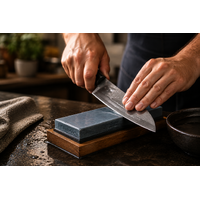

To sharpen a knife, hold the blade at a steady angle of about 15 to 20 degrees against an abrasive surface, work each side evenly until a fine burr forms along the edge, then refine and remove that burr on a finer grit. A whetstone provides the sharpest edge, a honing steel helps maintain that edge between sharpenings, and a guided jig keeps the angle consistent if you are not confident freehand. The single biggest factor is consistency: the same angle, every stroke.
A sharp knife is also a safer knife. A dull blade needs more force to cut, is more likely to slip and causes more damage when it does. That is why butchers and chefs keep a steel close at hand and touch up the edge through the day, rather than fighting a blunt knife. Here is how to do it properly, whichever tool you have.
Honing vs sharpening: know the difference
These two terms often get mixed up, but the difference between them matters. Sharpening removes a small amount of steel from the blade to grind a fresh, keen edge. You do this with a whetstone, diamond stone, sharpening system or abrasive sharpener. Honing does not really sharpen the blade: it realigns an edge that has started to roll over slightly with use. Honing is performed often, even in a busy kitchen.
Get the balance right, and your knives stay sharp with far less work. Hone little and often to keep the edge true, and only break out the stone or sharpening steel when honing no longer restores the knife's sharpness.
How to sharpen a knife on a whetstone
A whetstone provides the sharpest, longest-lasting edge and the most control. If using a water stone, soak it until the bubbles stop, usually 5 to 10 minutes, and keep it wet while you work. Sit it on a damp cloth or a stone holder to secure it. This will stop the stone from sliding.
1. Start with the Correct Grit. For dull or damaged knives, begin with a coarse stone (around 300 to 600 grit). For a knife that is still reasonably sharp, start with a finer stone.
2. Set the angle. Lay the blade on the stone and tilt it to about 15 to 20 degrees. A rough trick: stack two coins under the spine of a thin kitchen knife to get close to the right angle. Consistency matters with this step.
3. Raise a Burr. Keep sharpening until a slight burr can be felt by running your fingertip carefully on the back edge (never along it). When you feel a slight wire or burr the full length of the blade, that side is ready. Repeat on the other side.
4. Refine. Move to a finer grit (1000 and up) and repeat with lighter pressure to polish the edge and remove the burr. Finish with a few light alternating strokes.
How to sharpen a knife with a honing steel
A honing steel is the fast, everyday option for maintaining your edge. It does not create a new edge, but a few seconds on a steel will bring a slightly tired knife back to keen before each job. A diamond or coated steel does remove a little metal and can recover a dull edge unlike a polished steel.
To start, hold the steel vertically with its tip on a board or cloth. Set the heel of the blade near the top of the steel at roughly a 15 to 20 degree angle, draw the knife down and toward you so the entire edge sweeps across the steel, tip finishing at the bottom. Alternate sides, four or five light strokes each, no force.
Browse our range of sharpening steels, which includes polished, fine cut, sapphire and diamond options.
Using a guided sharpener or jig
Holding a perfect angle freehand takes practice. A guided system does that part for you, which is why a lot of professionals use one for consistency across a set of knives.
A clamp-style jig grips the blade and sets a fixed angle so every stroke is identical, while a V-shaped pull-through sharpener offers preset coarse and fine slots, often with an adjustable angle between 15 and 45 degrees. Slide the knife heel-to-tip through the coarse slot first, then the fine slot, with light, even pressure. It removes the guesswork and is hard to get wrong. See our guided sharpeners and tools range.
How to sharpen a serrated knife
A serrated knife is sharpened completely differently, and never on a flat stone, which would flatten the teeth. Each scallop has its own small bevel, so you sharpen them one at a time.
1. Use a tapered rod. A round ceramic or diamond sharpening rod that matches the size of the gullets. Slide it into each scallop until it fits snugly.
2. Match the existing angle. Serrated edges are bevelled on one side. Work the rod into each gullet at that same angle, a few light strokes, moving along the blade scallop by scallop.
3. Deburr the flat side. Lay the flat back of the blade on a fine stone or steel and make a couple of light passes to knock off the burr you have raised.
Most serrated knives, like a good bread knife, only need this rarely. If yours is cheap and badly worn, it is often easier to replace than to restore.
Test the edge, and stay safe
Two quick tests determine if you have sharpened your knife correctly. First is the paper test. Hold a sheet of paper and slice down through it: a sharp edge cuts cleanly without tearing. Or the second test is to run the blade through a ripe tomato. A sharp knife will bite into the skin with almost no pressure. If the knife slides or crushes, go back to the stone.
Sharpening puts your fingers near a keen edge, so a cut-resistant glove or chainmail mesh glove on your guiding hand is worth wearing, especially with bigger blades. Always run your finger off the edge to check the burr, never along it. We stock cut-resistant gloves for exactly this.
Keep your knives working at their best with the right gear. Mars Safety stocks sharpening steels, whetstones, guided sharpeners and cut-resistant protection, with fast Australian delivery and expert advice on the right tool for your blades.
Frequently Asked Questions
How do Butchers sharpen their knives?
Butchers rely mostly on a steel, touching up the edge through the day to keep it aligned rather than letting it go dull. Working knives like a boning knife are usually honed at closer to 20 degrees, which holds up better under heavy use than a finer kitchen angle. A few light strokes each side, with no force, brings the edge back between jobs. When honing no longer restores the bite, they sharpen on a stone to grind a fresh edge.
What angle should I sharpen a knife at?
For most kitchen and chef's knives, about 15 degrees per side gives a keen edge. Tougher working knives, like a butcher's boning knife, hold up better at closer to 20 degrees. Japanese-style blades are often sharpened finer, around 15 degrees, while sturdy European knives suit a slightly wider angle. The exact number matters less than holding the same angle on every stroke.
How often should I sharpen my knife?
Hone with a steel often, even before each session of heavy use, to keep the edge aligned. Sharpen on a stone only occasionally, when honing no longer restores the bite, which for a home cook might be every few months and for a busy kitchen far more often. How hard the knife is used and what it cuts both change the timing.
Can I keep a knife sharp with a steel alone?
A smooth honing steel maintains an already-sharp edge but does not create a new one, so eventually the knife still needs sharpening on a stone or jig. A diamond or coated steel removes a little metal and can recover a duller edge than a smooth steel, but it is not a full substitute for proper sharpening. Use a steel for upkeep and a stone for renewal.
Do I need to soak a whetstone before using it?
It depends on the stone. Water stones should be soaked until the air bubbles stop, usually 5 to 10 minutes, and kept wet while you work so the slurry can do its job. Oil stones use a little honing oil instead. Some splash-and-go ceramic stones need only a light wetting. Check what type yours is before you start.
When should I replace a knife instead of sharpening it?
Sharpen rather than replace as long as the blade is sound. Replace it if the edge is chipped beyond what a coarse stone will fix, the blade is cracked, or a cheap serrated knife is badly worn. A quality knife can be sharpened for many years, which is part of why a good blade is worth the money up front.
About the Author
Mars Safety, Knife and sharpening specialist
Mars Safety supplies knives, sharpening steels, stones and cut-resistant gear to butchers, meat processors and commercial kitchens across Australia from its Brendale base in Queensland. The team advises trade customers daily on keeping a working edge.